An intent-based interaction model: people say what they want in their own words, and the experience adapts to who they are and what they're doing. Approved as the design principle for a commercial banking platform.
yourbank.example/admin/sub-users/new
1 The request2 What it means3 Fine-tune4 Review
Mode
Here's what Freya gets
Check it, then continue. Nothing is applied yet.
Who
Freya HaleNew sub-user
Job
Runs payrollDirect deposit and payroll taxes
Accounts
Payroll Operating, Reserve, Tax3 matched
Can
View, send up to $25,000, see incomingApprove left off: one person shouldn't do both
One thing to sort out. Payroll Reserve can't send yet. Fix it on the next screen.
Here's what that means
Check this over. You can change anything.
Payroll OperatingRuns direct deposit
Payroll ReserveFunds the payroll account
Payroll TaxPays payroll taxes
View activityNeeded to send anything
Send paymentsUp to $25,000 eachPayroll Reserve can't send yet.
See incoming money
Approve paymentsLeft off. You didn't ask for it.
Here's what that means
Where each part came from. Everything stays editable.
Payroll OperatingMatched "Payroll" in the nameACH origination on · $25,000 limit
Payroll ReserveMatched "Payroll" in the nameACH origination off · can't send
Payroll TaxMatched "Payroll" in the nameACH origination on · $25,000 limit
View activityACH ViewerRequired by Send payments
Send paymentsACH OriginatorFrom the job "Runs payroll"
Approve paymentsACH ApproverRule: separation of duties
Approval pathGoes to a second administrator
ContinueShow full detail
Same step, three modes. Example data is fictional.
RoleLead designer
OriginSelf-initiated
CompanyB2B2C commercial-banking fintech
Year2026
Platform principleApproved by the Head of Product and Design in July 2026 as the design principle for future designs across the digital banking platform.
Live pilotPositive Pay, a fraud-prevention feature, is the first feature built on North Star. Build started July 2026. I'm the sole designer.
Roadmap influenceAfter my pitch, a Sub-User Admin rebuild on North Star principles is slotted for Q4 2027, with engineering sizing milestone one in Q1.
The problem
After the company was acquired by another fintech, two platforms ran on separate cores, and the gaps between them were everywhere. The roadmap turned into a list of gaps to close. A competitor shipped something, a client asked for something, and the answer was another feature with its own rules for how much to guide people, when to confirm and what to do when something went wrong. Clients met a different product on every screen.
Meanwhile, leadership had set an aggressive five-year goal to grow revenue and EBITDA. Closing gaps could keep clients from leaving, but it was never going to be the kind of innovation that grows a business. So I stepped back and assessed where the product needed to go.
The signs showed up everywhere: people typed into search far more than they used filters, frustration clustered on finding a transaction, and one of the most-visited admin screens was one sales avoided demoing. Each of those could have become its own fix.
Underneath it all, the product spoke the bank's language, not the client's. To block a type of ACH payment, a business had to know the right SEC code, like WEB, TEL or RCK, and find it in a list. People don't think in codes. They think in tasks: "stop payments that come in over the phone."
AI made the problem bigger. Without a shared model, every team would bolt AI on its own way, and the gap-closing would never end.
The question I brought to leadership wasn't "What should we build next?" It was "What product model will get us to the business we're trying to become?"
What the research showed
Commercial users aren't consumers. And they don't think in codes.
Six sources pointed the same way: one experience couldn't serve everyone, and banking jargon was getting in the way.
SME interviews
Two very different users
Interviews with subject-matter experts showed retail and commercial users need different things. A consumer payment-hub initiative hadn't accounted for high-volume, experienced users doing bulk actions, and it didn't scale. Someone sending a quick transfer doesn't need the same steps as a business sending a complex international wire before the cutoff. That's where the adaptive modes came from.
User testing
The menus were the friction
People spent more time hunting for codes in small, hard-to-find filters with long lists than they did typing what they needed into a single entry.
Product analytics
People reach for the search box
The ACH search box was used more than all three ACH filters combined, and it drew more rage clicks too. Transaction search drew rage clicks at roughly 6 to 12 times the rate of other search features.
Sales losses
Customization was the ask
In lost deals, client-driven requests were a repeated source of frustration, and the specific requests were for customization.
Competitive review
The bar was already set
Competitors offered separation of roles and account limits for each payment rail. That shaped the Sub-User Admin design.
Market trend
86% of Gen Z want AI-driven, personalized banking
versus 70% across all ages, in a 2025 survey of 2,000 banking customers. It's a consumer study, but it shows where expectations are heading, and the people running business accounts are consumers too.
Internal research and analytics are summarized and generalized for confidentiality.
The bet
Instead of patching gaps one feature at a time, build one adaptive experience that works across the whole platform: quick for experts, guided for newcomers, in plain language instead of banking codes. Every new feature plugs into the same system, so the company builds something it can sell, not just something to catch up.
The business case I made
I didn't pitch North Star as a nicer screen. I tied it, and Sub-User Admin as its first big application, to the three priorities company leadership had set out, and showed what it would do for each one.
Company priority
Client retention and satisfaction
Banks were asking for more control and configurable access, and each request became a custom change for one client. One configurable model replaces client-by-client changes.
Company priority
Commercial banking growth
Commercial clients need to separate who creates a payment from who approves it. Competitors offered finer controls, and missing per-account payment limits had come up in lost deals.
Company priority
AI as an accelerator, people decide
Rules first, with a person approving every change. Typed AI requests come later, and only once the company has settled how AI may use customer data.
Where the revenue comes from
I mapped three revenue levers: winning and keeping commercial deals, closing part of the new-client gap with a faster-growing competitor, and cutting the cost of one-off client requests. I labeled each one as an argument, not a measured result, and named what finance, sales and professional services still needed to confirm before anyone should rely on the numbers.
The idea: design for intent, not jargon
People act on the task, and the product does the translating. North Star rests on two ideas:
Speak the task, not the code. People describe what they want in plain language, and the system shows how it understood them before anything happens.
Fit the person and the moment. Someone who has set up access a hundred times doesn't need the same screen as someone doing it for the first time. Familiar work gets Speed, and new or risky work gets Guided.
The design shift · adaptive workflows
Fast where it's safe. Careful where it isn't.
Speed
Complete familiar work with the fewest possible interactions.
Guided
Progressive guidance for high-risk or unfamiliar tasks.
Investigation
Understand, track or resolve what happened.
Three guardrails
Caution wins.When checks disagree, the more careful mode takes over. Speed only applies when every check agrees.
Show what was understood.People always see how their request was understood, and can adjust it.
Say what wasn't understood.Partial results plus one question beat a confident wrong answer.
How it scales
The same pattern that replaces a code list works for a search bar, a report, a permission change or a fraud decision. Under the hood, every moment runs in one of three modes, and five checks decide which one fits this person and this task. It runs on rules today, and AI can make the same calls later without anyone redesigning what clients see.
The mode is chosen per moment, not per screen. When checks disagree, the more cautious mode wins, and Speed applies only when every check agrees.
FindSearch in plain language"Payments sent over the phone" instead of TEL. In build now in Positive Pay.
CreateBuild a reportAsk for a report in plain language or pick a data set.
GrantGive someone accessDescribe the job; review what it means before anything changes.
DecideResolve fraud exceptionsDecide whether to pay or return checks that look wrong. Positive Pay, the live pilot.
Same intent-first pattern, same three modes. The stakes rise from left to right, and the pattern holds.
The pattern in practice
It starts small, with one jargon-heavy list in a feature being built today, and scales to some of the hardest screens on the platform.
Before · Speak the bank's language
SEC code
Select a code ▾
ARC
BOC
CCD
PPD
RCK
TEL
WEB
You have to know that "TEL" means payments authorized over the phone.
→
After · Say what you mean
⌕payments sent over the phone
Understood asTEL · Telephone-initiated paymentsBlock these payments
The code is still there. People just don't need to know it.
Where the pattern starts, in Positive Pay (in build): adding an item to an ACH block list. A natural-language search sits on top of the SEC code list, so people search the way they think. Illustration recreated for this page.
Example · finding a payment, today
Find one payment. Open five menus.
Filtering means building the query by hand, one menu at a time.
Illustrative · ACH filters today
Filter Type ▾Company ID ▾SEC Code ▾Transaction Criteria ▾Applies to ▾
Company IDSearch
AB1231434Alpha Corporation
BC13243523Beta Corporation
CC435235Gamma Inc
ApplyReset
SEC CodeSearch
ARC
BOC
CBR
CTX
DNE
ApplyReset
Transaction CriteriaItem count
BelowAbove
Item amount
$ Below$ Above
Total amount
$ Below$ Above
ApplyReset
Plus Filter Type and Applies to. Pick, scroll, check, apply. Repeat for every field.
Search > filtersPeople used the ACH search box more than all three ACH filters combined.
Rage clicksRapid, repeated clicks on that same search box outnumbered the filters' too.
6–12×Transaction search drew rage clicks at roughly 6 to 12 times the rate of other search features.
Source: product analytics over about 90 days, generalized for confidentiality. Illustration uses fictional data.
Task 1 · table search · illustrative
One search bar. Three responses.
The bar doesn't change. One line of interpretation beneath it does.
Speed
Familiar user, clear query
⌕ ACH payments last month over $5,000
Showing
Last monthOver $5,000
Results apply on Enter. Tap a chip to adjust.
Guided
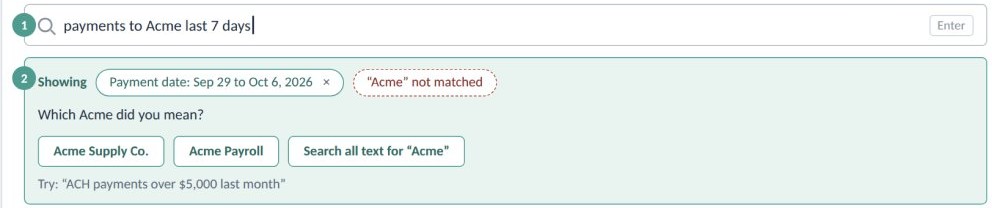
New user, or part is unclear
⌕ payments to Acme last 7 days
Showing
Last 7 days"Acme" not matched
Which Acme did you mean?
Acme Supply Co.Acme Payroll
Applies what it understood and asks one question. Never a blank screen.
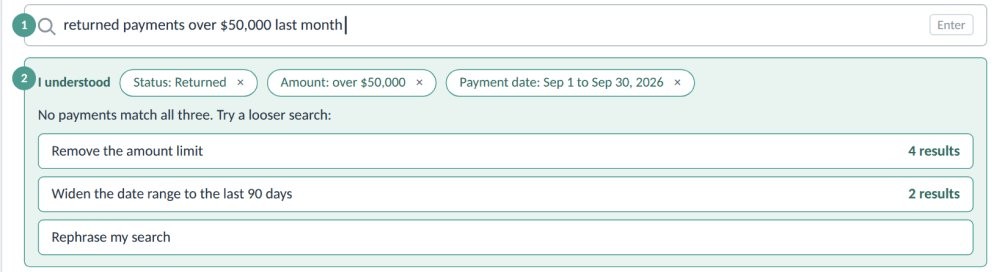
Investigation
Zero results, or rephrasing
⌕ returned payments over $50,000
I understood
ReturnedOver $50,000
No payments match both.
Remove the amount limit4 results
Rephrase my search
Explains what happened and offers a way forward.
Same pattern, two very different jobs · proposed designs
Natural language in the search bar
SpeedType a sentence. It just works.Results apply on Enter, with one new line showing how it was understood.
GuidedUnsure? It asks one question.It applies what it understood and asks only about the unclear part.
InvestigationNo results? It shows a way out.It explains what it understood and offers looser searches, with result counts.
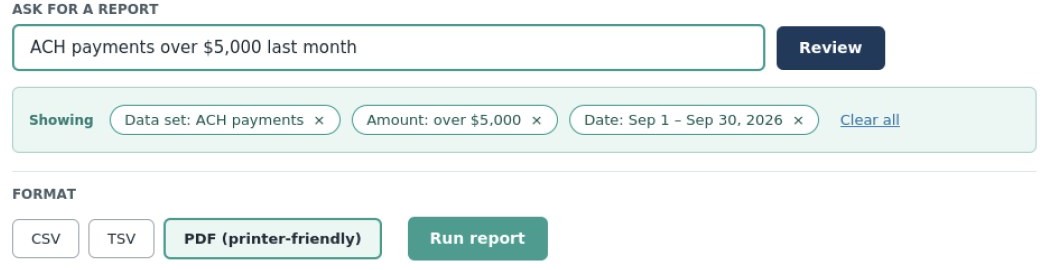
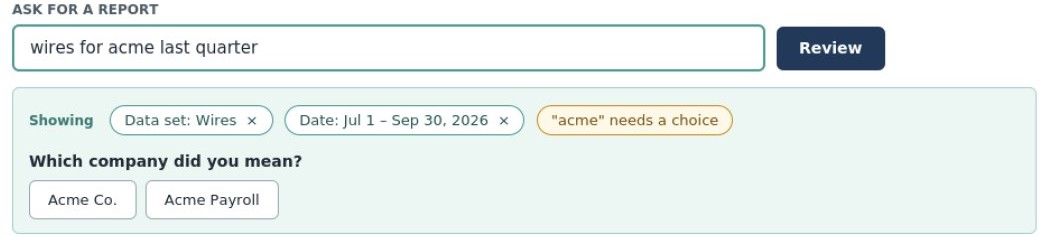
Flexible reporting in plain language
SpeedAsk for a report in a sentence.The request fills itself in. Pick a format and run.
GuidedOne question, not a form.Matched parts stay filled in; it asks only which company you meant.
FormatsOnly offers what works.Formats adapt to the data set, so people never pick one that fails.
Example data is fictional.
Applying it: Sub-User Admin
Business admins set up their team's access one person at a time, with no reusable roles, no per-account payment limits and no way to check permissions before saving. Sales avoided demoing it, and the missing per-account limits had come up in competitive deals.
The work started as an assigned visual refresh. I added Bulk Apply, which nobody had asked for, then plain-language input, and then rebuilt the whole flow on North Star principles with a staged plan the business could fund one step at a time.
Task 2 · Sub-User Admin: the setup
Who on your team can do what, and where.
That's Sub-User Admin: how a business gives its team access to accounts and payments.
Access to AccountsPlease select the Basic Service level for each account.
Checking ****0058 · Payroll OperatingBasic View Only
Checking ****5321 · Payroll ReserveBasic View Only
Checking ****7853 · Payroll TaxBasic View Only
Access is set user by user, account by account.
A list box for every account.Service levels are set one account at a time.
A separate screen per service.ACH Credit, ACH Debit, Wires, Real-Time Payments, Fraud Prevention, Positive Pay.
No reusable roles.No testing before saving.
Sub-User Admin · walk
Walk: Bulk Apply sets access by rule.
Add sub-user: Freya Hale
✓ 1 Profile2 Accounts3 Services and limits4 Review
ModeGuidedOne decision at a time, review before applying.
You have 48 accounts. Try Bulk Apply for a quicker setup.
Payroll Operating ****0058✓Basic
Payroll Reserve ****5321✓Basic
Payroll Tax ****7853Basic
Bulk ApplyAccess level
Basic (view, transfer) ▾
Apply to
All accounts of a type: Checking
Accounts with a word in the name
Match another user
17 accounts will changeShow accounts
Preview changes
1 · Guided mode.One decision at a time, review before applying.
2 · The system suggests it.It notices you have 48 accounts and offers a quicker setup.
3 · Preview first."17 accounts will change" before anything is saved.
Sub-User Admin · run (North Star)
Run: say the job, check what it means.
1Say the job.
What should Freya be able to do?Describe the job, not the service.
Give Freya send access to payroll accounts
Try
Freya should approve payments on all accountsMatch access from another user
ContinuePick accounts myself instead
2Check the translation.
Here's what that meansCheck this over. Nothing is saved yet.
✓ Payroll Operating ••0058
✓ Payroll Reserve ••5321
✓ Payroll Tax ••7853
View activity
Send payments
See incoming money
Approve payments
Left off: you didn't ask for it, and one person shouldn't do both.
3Review, then send.
Before you send thisPlain-language summary of what changes for Freya.
On Payroll Operating, Freya can view activity and see incoming money. No payment access.
On Payroll Reserve, Freya can view activity and send payments. Payments over $25,000 need a second approver.
On Payroll Tax, Freya can view activity.
Send for approval
Same flow in Speed, Guided and Investigation. The mode decides how much of each step you see.
Proposed designs. Example data is fictional.
Prototype, Speed mode. The admin picks a job instead of ticking boxes, sees a plain summary of what the new user gets, fixes the one account that won't work, and reviews everything in plain language. Nothing goes live until a second administrator approves. Example data is fictional.
The hard part: getting three groups to yes
Winning over leadership and product was as big a job as winning over engineering. Each group needed a different reason to say yes, so I built a different case for each one.
Leadership needed to see how one model served the company's goals: retention, commercial growth and a safe path to AI.
Product needed to see the product model it unlocked, and a staged plan they could fund one step at a time.
Engineering needed to see the logic and the risk controls.
Engineering's concern about AI
Engineering pushed back on the AI piece, and the concern was fair. Banking data is sensitive, and a model guessing at intent is a hard thing to put in front of a business that's moving money. I didn't treat that as an obstacle to argue past. I changed the plan so the first version earned trust on its own.
How it's built
Same experience. Different engine.
Rules-based or AI, the person sees the same readback. So the design doesn't change if the engine does.
Rules-based keeps everything inside the company's systems, and every phrase can be tested.
The engine · swappable
Rules-basedA library of phrases we write.
AI-assistedHandles open-ended phrasing.
↓
The readback · identical either way
Showing: ACH payments · Last month Freya can: view activity, send payments
↓
The modes · same rules either way
SpeedGuidedInvestigation
Decision 1
Rules first, AI later
The first version runs on rules, using data the platform already has. No data leaves the company. AI can be added later behind the same experience.
Decision 2
Build from what exists
Everything is built from the current design system, so there are no new components to maintain and the change is cheap to adopt.
Decision 3
Make the logic testable
I wrote technical specs for the engineers. Each page lists its checks in order and stops at the first match, so behavior is predictable and easy to test.
Decision 4
Prove it on a live feature
Positive Pay became the pilot, so the model would be judged on a real release, not a deck.
Those four decisions answered engineering. For leadership and product, I named the risks up front and made a clear ask.
Risks, named up front
RiskWhat could go wrongHow the plan handles it
ScopeMany parts: ACH, wires, pass-through, imports.Start with the shared pieces (list, add flow, review), then add services.
DataGrant history and entitlement mapping may not exist yet.The first two milestones need neither. Only the final stage depends on them.
CapacityEngineering capacity for 2027 isn't confirmed.Start with milestone one. The full scope may run into 2028.
AIUsing AI with customer data isn't settled.Ship rules-based first.
The ask
Keep North Star as the direction for every new Sub-User Admin design.
Slot Sub-User Admin as a 2027 horizon item, with engineering sizing the milestones first.
Start with the first milestone once sizing says it's doable.
Agree how we'll measure it before building, by testing with business administrators against today's screen.
I closed with an invitation to the other product teams in the room: the three modes are meant to be reused anywhere people and permissions show up.
CrawlDesign systemBring the screens onto the shared system.
WalkBulk ApplySet access for many people at once, with preview and undo.
RunReusable rolesDefine a role once and assign it to anyone.
North StarThree modesSpeed, Guided and Investigation for every setup.
Status: slotted for Q4 2027 after my pitch, with engineering sizing milestone one in Q1 2027. Roadmap space had been lost after the company was acquired, so getting it back in line took a business case, not just a design.
How success would be measured (a plan, not results): time to complete setup, wrong permission grants, the catch rate when a mistake is planted in a setup, and support contacts.
What I learned
I learned not to wait to be handed a project. I looked for the gaps and brought the idea to the table myself. I also learned that one idea needs more than one pitch: what I showed product leadership was different from what I showed engineering, because each needed a different reason to say yes.